






How Long Do Garage Door Openers Last? Lifespan, Brands, and Key Longevity Factors
A typical residential garage door opener lasts between 10 and 15 years. That range holds under normal operating conditions: a household averaging three to five cycles per day, a mechanically sound door, and a climate that does not push the hardware to its limits. If you change any of those factors, the timeline shortens. Wear builds up fast. Maintain the system well, and some openers run reliably past the 15-year mark.
Understanding the Average Garage Door Opener Lifespan
Think of your opener motor like any workhorse running on a fixed cycle count. The motor itself is often the last component to fail. The gear kits, drive sprockets, and logic boards usually wear out first. Each time your door travels up and down, these internal parts absorb a small amount of stress. Over thousands of cycles, that stress adds up. Eventually, components break. The average garage door opener lifespan of 10 to 15 years reflects roughly 10,000 to 20,000 cycles under normal use. A garage door motor’s lifespan depends directly on how hard it works on each cycle. A motor pulling a balanced door on a lubricated rail does very little work. A motor straining against worn springs or a bent track works much harder. This extra wear shows up years earlier than you might expect.
The opener’s longevity is closely tied to the health of the door itself. Most people assume the motor does the heavy lifting, but that is not how the system works. The springs carry the door’s weight; the motor manages the movement. When springs lose tension, the door becomes heavy. This strains the motor. The opener compensates by drawing more current and straining its drive components on every cycle. Understanding the importance of garage door springs is central to understanding opener longevity. A balanced spring system keeps motor strain minimal. The lifespan of your garage door springs directly impacts how long your opener survives. Springs on a standard residential door are rated for a set number of cycles. When they lose tension, the opener quietly absorbs the extra load on every single run.
Key Longevity Factors Affecting Your Opener
Several factors determine whether your opener reaches the 15-year mark or wears out at year eight. These factors are not equally weighted. Some you can control with maintenance, while others are built into your environment. Here in North Texas, environmental factors compound quickly. The extreme summer heat in Denton, Argyle, and Sanger dries out rail lubricants in a few short months. It causes metal parts to expand and contract, forcing motors to work harder. This heat stress is not obvious on any single day. But over a decade of Texas summers, it shortens the life of drive belts, plastic gears, and circuit boards. Cycle frequency is the other big factor. A household with multiple drivers coming and going all day puts double the wear on the system compared to a home with one car.
- Drive Type Mechanics: Belt drive openers, typically rated for 10 to 15 years, offer quiet operation. However, they can stretch over time, especially in high humidity where rubber degrades faster. Chain drives are mechanically tough and can outlast belts, but metal-on-metal contact requires regular lubrication. A neglected chain will chew through its sprocket teeth. Screw drives have fewer moving parts, which sounds like an advantage, but they are sensitive to temperature. During cold snaps, stiff grease puts a heavy load on the motor.
- Door Balance and Weight: An unbalanced door forces your opener to struggle on every cycle. Your door must be calibrated so the motor manages the movement instead of fighting gravity. An unbalanced door strips drive gears over time. This damage builds up quietly until the gears fail completely.
- Spring Tension Maintenance: Springs are rated in cycles, and as they lose tension approaching the end of that rating, the load they transfer to the opener increases. A worn spring set acting as a silent drain on a brand-new motor is one of the more common causes of premature opener failure.
- Regular Lubrication: Applying a silicone-based lubricant to the rail, chain, or screw prevents friction and motor drag. This is one of the simplest ways to protect your opener.
If you live in Denton County, including Corinth, Lake Dallas, Lantana, or nearby, and you are not sure if your system is balanced, a professional garage door inspection is the fastest way to check. Denton Overhead Door offers same-day service with clear pricing and no hidden fees. Call us at 940-260-3351.
Garage Door Opener Brand Lifespan Comparison
LiftMaster and Chamberlain share the same parent company, the Chamberlain Group, which is important when comparing their internal parts. Both brands use strong motor designs with steel-reinforced belts and advanced logic boards. Both integrate with myQ smart-home technology. In the field, LiftMaster units are sold through professional dealers and installed by certified technicians. This means the rail alignment, force settings, and travel limits are calibrated correctly from day one. That professional installation is why they easily last 12 to 15 years. The comparison between the two brands does not come down to hardware. It is about installation. It comes down to how they are installed. Chamberlain units are sold in retail stores for DIY installation. They use the same core motor technology but can wear out faster if the rail is misaligned or the force limits are set incorrectly.
Genie holds a strong position in the residential market, especially because of its history with durable screw-drive designs. Modern Genie units have shifted toward quiet belt-drive systems with Aladdin Connect smart-home integration. Their typical lifespan runs 10 to 14 years. They perform well. Older screw-drive models built Genie’s reputation for toughness, and that reputation is earned. However, any opener will wear down from mechanical drag if you do not maintain the door itself. A Genie belt drive on a door with failing springs will not outperform a LiftMaster on a balanced, well-serviced system.
- LiftMaster (Professional Grade): Average lifespan of 12 to 15 years; highly durable motors; excellent parts availability nationwide; professional installation ensures optimal rail alignment, force calibration, and maximum longevity from the first cycle.
- Chamberlain (DIY & Retail): Average lifespan of 10 to 15 years; shares internal motor technology with LiftMaster; highly reliable when installed correctly; lifespan can be shortened if DIY installation results in improper rail alignment or incorrect force settings.
- Genie (Reliable Performer): Average lifespan of 10 to 14 years; strong history with durable screw-drive systems; modern belt-drive units offer excellent quiet performance; highly competitive warranty coverage across product lines.
When to Repair vs. Replace Your Garage Door Opener
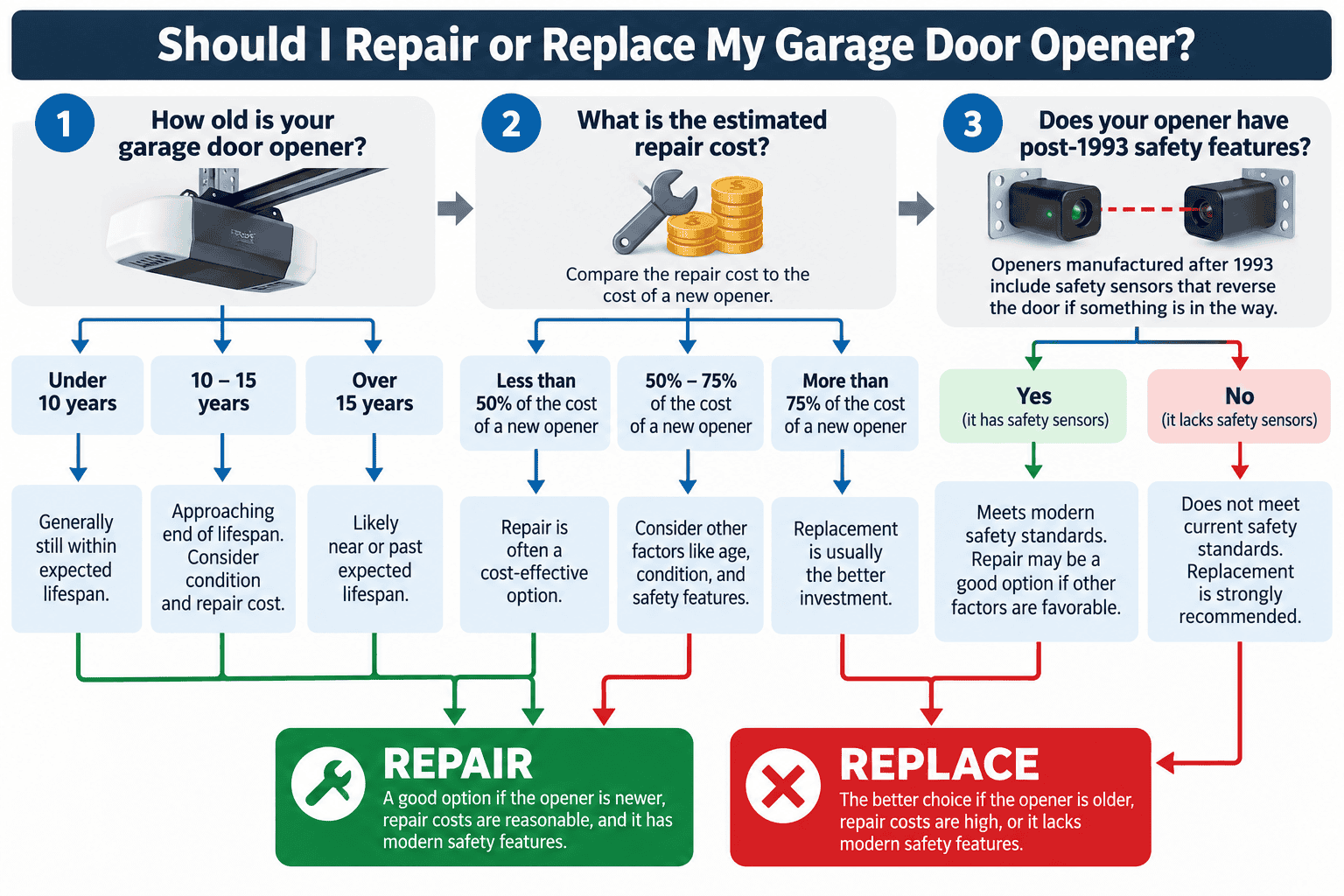
The decision to repair or replace a garage door opener comes down to cost, but the math changes depending on what failed. A worn drive gear or a broken belt is a simple repair on a unit that is only five or six years old. The motor and logic board still have plenty of life left. Repairs make sense. When the logic board fails on a 12-year-old opener, the math shifts. Sourcing and installing a new board on an old unit often costs close to a brand-new opener. A new unit also comes with a warranty and modern safety features. The same is true for a failed motor capacitor on an older system. Getting a professional assessment before you pay for a repair can save you from spending money twice. For a detailed cost breakdown, our guide on whether to repair or replace a garage door opener walks through the math with real numbers.
Our team at Denton Overhead Door has had this conversation with homeowners hundreds of times. Our customers appreciate honest, pressure-free advice:
“Caden was great and personable. He did a great job and was very professional. I highly recommend him.” – Jack Taylor
“Came out the same day to assess the problem. Got the parts and came back out the next morning. Installed an entire new motor and 2 new pads and reprogrammed my car all in about 1hr. Cayden was very kind and cleaned up afterwards very well. We’ve used this company before and will continue to use them.” – Judy Gore
When you are weighing a repair estimate against replacement cost, you need a technician who gives you a straight answer, not a sales pitch. Denton Overhead Door offers a free estimate with clear pricing and no hidden fees. Call us at 940-260-3351.
Federal Safety Standards and Age-Based Replacement Rules
Age is not just about how well your system runs. Safety comes first. For openers built before certain regulatory dates, it is a serious safety issue. The Consumer Product Safety Commission (CPSC) has clear standards that make your opener’s manufacture date a critical detail, not just a trivial detail.
- Pre-1982 Units (Immediate Replacement Required): Openers built before 1982 lack the safety features found in the voluntary standard ANSI-UL 325-1982 (per the CPSC’s 1991 release on non-reversing garage doors). Some of these units only stop the closing door instead of reversing it. Others fail to reverse at all because of age, bad installation, or lack of maintenance. Since you cannot adjust or repair them to meet modern safety levels, they must be disconnected and replaced immediately. Between March 1982 and June 1990, at least 45 children died from being trapped under closing garage doors that did not reverse (per the CPSC 1991 non-reversing garage doors release). That number rose to 54 by 1992 (per the CPSC’s 1993 final rules release). These are not abstract regulatory footnotes.
- 1991-1992 Mandates (UL 325 Compliance): Under federal mandates established through the Consumer Product Safety Act, all automatic residential garage door openers built on or after January 1, 1991, must meet the entrapment protection rules of UL 325 (per the CPSC 1993 final rules release).
- Post-January 1, 1993 Standards (16 CFR Part 1211): Openers built on or after this date must comply with 16 CFR Part 1211, the federal Safety Standard for Automatic Residential Garage Door Operators. This standard requires an external entrapment protection device: either an “electric eye” photoelectric sensor, a door edge sensor, or a constant contact control button that requires continuous physical pressure to close. It also requires a warning sticker near your wall button (per the CPSC 1993 final rules release).
- The Two-Inch Block Reversal Test: To verify that your opener is safe, place a two-inch wooden block flat on the floor in the door’s path and close the door (per the CPSC 1991 non-reversing garage doors release). Under federal rules, the opener must reverse within two seconds of touching the block (per the CPSC’s 1992 proposed rules release). The system must also reopen the door within 30 seconds of starting down if it senses the door did not close fully (per the CPSC 1992 proposed rules release). Homeowners should run this test monthly (per the CPSC 1993 final rules release).
Regular maintenance for garage door openers is the most reliable way to protect your investment and your family. Simple monthly checks can catch developing problems before they become motor failures. Do not skip them. Test the safety sensors and verify the door’s manual balance by disconnecting the opener and lifting the door by hand to see if it holds at mid-travel. If your door fails the block test, adjust the force settings per your owner’s manual. If the problem persists, contact a technician for an inspection rather than continuing to use the door.
Frequently Asked Questions About Garage Door Opener Lifespan
How often should you replace your garage door opener?
Most residential garage door openers last between 10 and 15 years. If your opener is older than 15 years, or if it was manufactured before 1993 and lacks modern photoelectric safety eyes, you should replace it immediately to ensure compliance with federal safety standards and protect your family.
What is the average cost to replace a garage door opener?
Replacement costs vary based on several factors: the motor’s horsepower rating, the drive type (belt, chain, or screw), smart-home features, and local installation rates. Getting a free estimate with clear pricing from a licensed technician is the most reliable way to understand what a replacement will cost for your specific setup. This protects you from paying for more horsepower or features than your door really needs.
How do I know if my garage door opener needs replacing?
Common signs it’s time to replace a garage door opener include unusual grinding or squeaking during operation, excessive chassis vibration, intermittent reaction to the remote or wall button, and delayed response times that weren’t present when the unit was new. A motor that runs audibly but fails to move the door, or a logic board that requires repeated resets, typically indicates that repair costs will approach or exceed the cost of a new unit. Failure to reverse when encountering an obstruction is both a mechanical warning and a federal safety concern.
What is the best brand of garage door opener?
LiftMaster and Chamberlain are widely regarded as the most durable options in the residential market, with strong motor designs, excellent parts availability, and myQ smart-home integration. Genie is also highly regarded, particularly for its screw-drive heritage and competitive belt-drive lineup. Installation quality and ongoing maintenance matter just as much as the brand name: a well-installed Genie on a balanced door will outlast a poorly installed LiftMaster on a neglected one.
Should I get a 1/2 HP or 3/4 HP garage door opener?
A 1/2 HP motor handles standard single-car and lightweight double-car residential doors without issue. For heavier doors, such as solid wood, carriage-style, or heavily insulated double doors, a 3/4 HP motor is the better choice. The additional horsepower reduces strain on the motor during each cycle. This translates directly to smoother operation and a longer service life.
Schedule an Inspection Today
A well-matched opener, properly installed on a balanced door with healthy springs, can run reliably for well over a decade. The brands that consistently reach the top of that range, including LiftMaster, Chamberlain, and Genie, get there partly because of their hardware, but mostly because the systems they are installed on are maintained. Springs get replaced before they fail completely. Rails stay lubricated. Safety sensors get tested monthly. When those basics slip, even a premium opener starts working harder than it should, and the lifespan contracts accordingly.
A technician who knows what to look for can assess motor strain, verify spring tension, and run the safety reversal test in under an hour. That hour can add years to a system that is still worth saving. It can also give you the honest information you need to make a smart replacement decision before a failure leaves you stuck with a door that won’t open.
Homeowners across Denton County, including Krum, Sanger, Shady Shores, Copper Canyon, and the surrounding communities, can reach Denton Overhead Door at 940-260-3351 for same-day service with clear pricing and no hidden fees. Our team brings family-owned expertise to every job. Schedule your inspection today.
Categorised in: Garage Door Openers